Barley
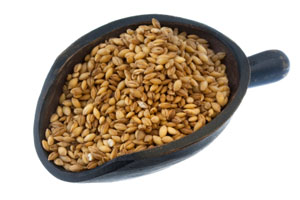
Barley is one of the earliest known cultivated grains, appearing at roughly the same time as wheat. In medieval Europe, bread made from barley was considered peasant food, while the upper classes consumed wheat.
Barley was also combined with wheat to make a very nutritious bread, however in modern times it seems to have fallen out of favour for bread making, and the populace demand for mass produced, cheap, wheat loaves was a major contributory factor.
Barley does not contain a lot of gluten, which means that on its own it is not good for making bread, unless unleavened bread is made. However as it does contain some gluten it means that it is unsuitable for people on a gluten free diet suffering from celiac (coeliac) disease.
Cooking:
Barley can be used to thicken soups and stews, or made into a nutritious risotto or pilaff instead of using rice. Cooked into a sweet porridge type mix it is also eaten for dessert, although it does require sweetening for most palates.
Barley water, the cordial drink is also made from this grain, and of course barley beer, which is possibly the first drink developed by Neolithic man.
Storing:
As with all flours, barley flour should be kept in an airtight container, and stored in a cool area, or in the freezer. Other forms of barley should also be kept in cool, airtight conditions to maintain their freshness until they are used or reach their 'use by' date.
Alternative names/types:
Flaked barley
This is partially cooked barley that has then been flattened and dried, so
that it resembles rolled oats. It can be used pretty much the same as rolled
oats and makes good porridge or muesli.
Milled barley
Another name for pot barley.
Pearl barley
The husk and the germ of the grain have been removed during processing. Pearl
barley is best used as a nutritious addition to soups and stews.
Pot barley
This is grain that has only had the husk removed, and imparts a nutty flavour.
Because it still has the husk of the grain it takes longer to cook than pearl
barley.
Scotch barley
A coarse unhusked grain, requires a reasonable amount of cooking to make it as
palatable as other forms.
Nutritional information:
Typical values per 100g of product (barley)
Energy - 354 kcal
Protein - 12g
Carbohydrate (total) - 73g
Carbohydrate (sugars) - 1g
Fat (total) - 2g
Fat (saturated) - 0g
Dietary fibre - 17g
